

Priscilla’s
Bird photography
Photos from personal trips AND trips with
“Birds of Oregon and General Science” (BOGS)
of Celeste Campbell Center



BOGS Summer Walk 7, Fern Ridge Royal
Thursday, July 31, 2014
A Summer record of 14 birders turned out for our birding trip to Fern Ridge Reservoir, just as the southward shorebird migration has really kicked into gear . This Summer our birding group has typically numbered eight to ten, so this was nearly double the usual number. Was it the prospect of seeing shorebirds that brought out so many people, or was it just happenstance? The weather was still expected to be hot, so it wasn't the prospect of cool weather that brought people out.
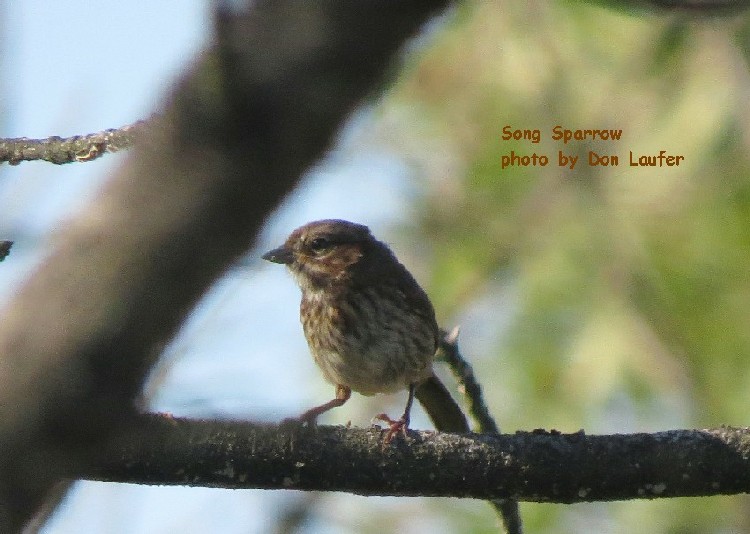
As usual, some folks met us out there while the majority of us arranged car-pooling at Campbell Center at 8am. We started walking about 8:25am. The group of shrubs and trees south of the trail just after leaving the parking lot always has some birds flitting around and/or calling.; and sometimes Vesper or Grasshopper Sparrows are seen here. In fact, a day or two after our trip Alan Contreras and Thomas Meinzen reported a Clay-Colored Sparrow and a Brewer's Sparrow in that area. A year ago in July our BOGS group saw a Brewer's Sparrow at Fern Ridge, though it was a short distance away, south of this group of trees, on the dike that heads towards the Barn Pond. We amused ourselves along this stretch of Royal for ten or fifteen minutes. We struggled a bit with a Song Sparrow which did not have a spot on the breast nor much if any of an eyestripe, and we found Savannah Sparrows ahead of us on the trail. There was also a bird which Don photographed which looks like it might be a female Goldfinch, but otherwise, we didn't see anything out of the ordinary in this patch this time.

The center of "action" for most of the morning, was along the dike south of and further along the trail, where the ponds have begun to dry up, leaving the kinds of mudflats preferred by shorebirds. Once we got there, we quickly discovered a wonderful mix of birds. There were birds everywhere in the remaining water and on the muddy shores around it. Sizes ranged from the large Canada Geese, down to the 6" Least Sandpiper "peeps"; and while there was some obvious grouping by species, such as with the Dowitchers and the Western Sandpipers, overall the impression was more that of a randomly scattered mix, especially the birds which were present in small numbers.
Here is our list of birds for this trip, though I may have overlooked or forgotten one or two
- Canada Goose
- Mallard
- Cinnamon Teal
- American White Pelican
- American Bittern
- Great Blue Heron
- Green Heron
- Osprey
- American Kestrel
- Peregrine Falcon Immature
- American Coot
- Semipalmated Plover
- Killdeer
- Black-necked Stilt
- Solitary Sandpiper
- Greater Yellowlegs
- Western Sandpiper
- Least Sandpiper
- Long-billed Dowitcher
- Wilson's Phalarope
- Caspian Tern
- Black Tern
- Acorn Woodpecker
- Northern Flicker
- Purple Martin
- Tree Swallow
- Marsh Wren (H)
- European Starling
- Cedar Waxwing
- Savannah Sparrow
- Song Sparrow
- Red-winged Blackbird
- Yellow-headed Blackbird
- Brown-headed Cowbird
It is not too often that we find ourselves confronted with so many species of birds all at once like this. On more typical birding outings, we see or hear one or two species at a time and most of the group attend to those one or two birds. In contrast, the situation at the mudflats was more like looking at a tray onto which a jar of assorted nuts had been poured. Everywhere in the group people were seeing birds of interest and calling attention to them. Sometimes I didn't know which way to look or which group to listen to and work with. It was impossible to keep track of all the birds being seen and discussed in an organized group-effort sort of way, so people automatically began working in small groups of two to five, using one of the scopes and their binoculars, to view and try to identify a particular bird. These small groups broke up and re-organized themselves as progress towards an ID for a bird, or as birds of interest slipped out of view behind bunches of grass at the edge of the water, or as frustration built up at not being able to resolve the species of a particular bird. This semi-organized chaos was the scene for close to two hours.
The one disadvantage was that the birds were a fair distance away from us. While this made it difficult to see some of the details clearly enough to identify some of the birds * with binoculars *, we did have four spotting scopes to make use of, and those were extremely helpful.
During this same period, the occasional American Bittern or other bird would be seen flying nearby. My favorites among these temporarty diversions from the shorebird action, were a Caspian Tern and a pair of Yellow-headed Blackbirds. I love to see Caspian Terns. It's especially a treat to get a view of them so far from the coast. As for the blackbirds, I've seen reports of Yellow-Headed Blackbirds from the Royal Ave area from time to time, but the only areas I've seen them in before have been Perkins Peninsula Park and from the parking lot on West 11th further west of Perkins Peninsula. We didn't see or hear them when we were further west at Zumwalt Park this Summer.
What was especially fun for me was that the Yellow-Headed Blackbirds at the mudflats were making a lot of vocalizations when they flew around us from time to time. They weren't making the same raucous grating call they make in the cattail marshes in Spring. It was similar in quality, but a shorter sound with some bit of rhythmic complexity to it.
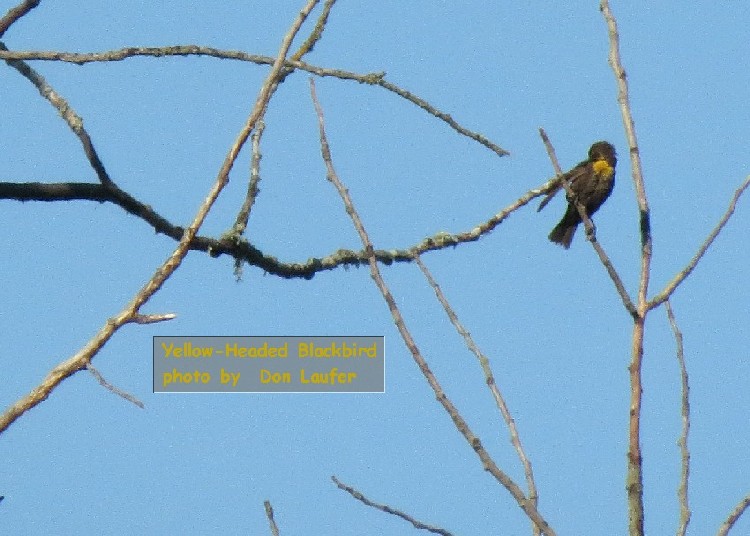
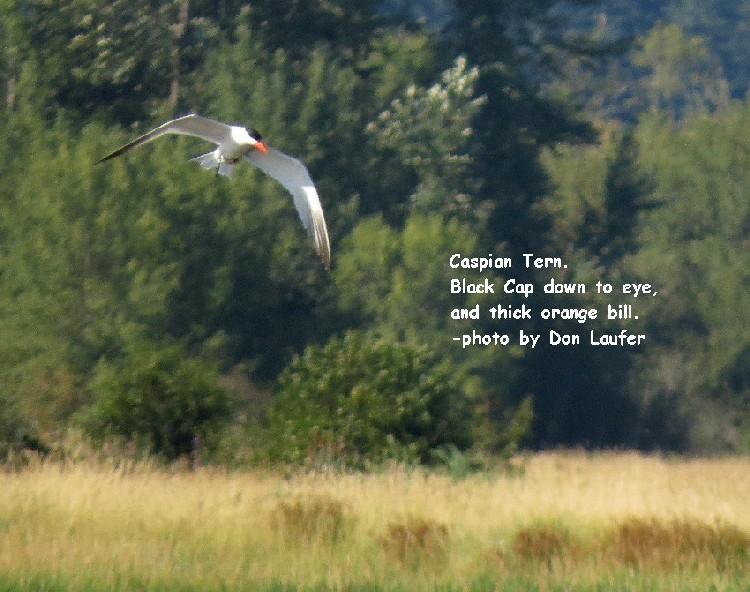
Besides the American Bittern, Caspian Terns and YH-Blackbirds, we also had "fly-bys" by an Osprey, some American White Pelicans in the distance, and saw Purple Martins and a Green Heron in the trees. There was also a bird in the trees over near the platform, which we could not identify. It might have been a juvenile Robin, or perhaps a Northern Flicker. A photo was taken, but it does not reveal quite enough detail to ID the bird.
Speaking of photos, Don Laufer did his usual bang-up job of providing us with a large set of nice very photos; but this time we also have a set of photos contributed by Terry Smith. You'll see an annotation on his photos giving him credit for his work, (as I try to always do when anyone contributes photos). Don took many photos of the shorebirds, and I had to send about a dozen of them to Floyd to get his help at ID-ing some of those birds. Some of them were just too far away to reveal sufficient field marks for a conclusive ID, but we at least got them narrowed down to one or two possibilities in most cases.
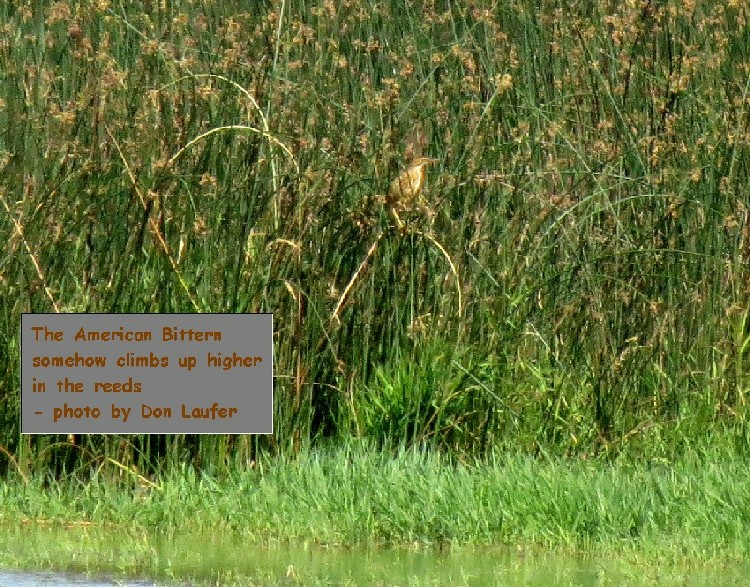
After an hour and a half of rather frenetic activity looking at and trying to identify shorebirds, most of our group began heading for the platform. I stayed behind with a few folks at the shorebird location for another 10 or 15 minutes. By the time we reached the platform, the group had already found a handful of interesting birds to look at. There was an American Bittern posing crazily off in the distant marshes. At one point it seemed to somehow climb up higher in the reeds. Don documented this Bitterns antics.
Black Terns were flying here and there, and a juvenile Black Tern (my first of this year) was perched on some branches out in the pond to the southwest of the platform. Don got a photo of that bird too. Both Don and Terry got nice photos of White Pelicans which flew in and perched on a log not too far from the platform, allowing very nice photos to be taken. A while later, an American Kestrel landed in the trees to the northeast - the tall trees which border the smaller pond over that way. Later, an immature Peregrin Falcon landed in those same trees, causing quite a flurry of activity from a flock of juvenile Red-Winged Blackbirds. They swarmed around the falcon, and Terry captured that scene perfectly in one of his photos. That is perhaps the most artistic photo from this trip. Don got a lot of nice photos of the Peregrin falcon too, including a few different angles and one of the falcon eating something.
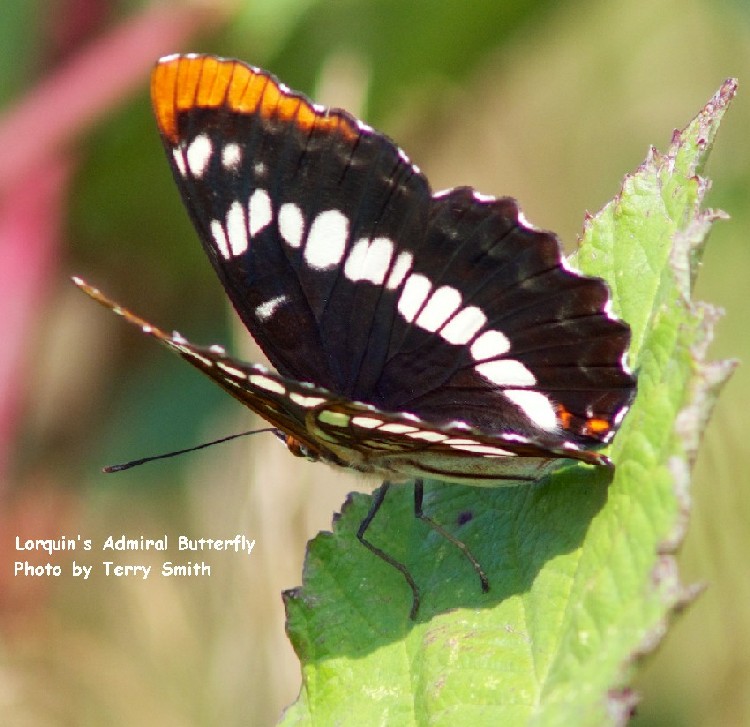
With the four spotting scopes available, everyone got to enjoy nice long looks at the Bittern, Kestrel and Falcon. Terry Smith got a few non-bird shots on this trip too. He got a beautiful photo of a Lorquin's Admiral Butterfly. He also came across a field mouse or meadow vole and got a nice close-up of that. My thanks to Don and Terry for their great photographic contributions to the photo album for this trip!
ENJOY!
Priscilla